
Expertise • Enthusiasm • Excellence



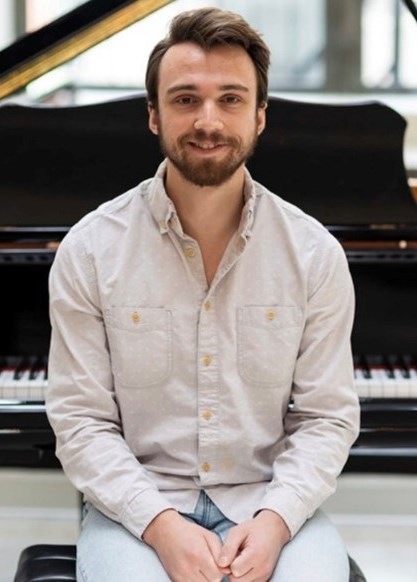
Daniel Nerger
Piano, Suzuki Piano
A multi-faceted pianist, educator, composer and producer, Daniel has a B Mus in Piano Performance from Boston Conservatory at Berklee, where he also won the Honors Piano Competition. He is a gold and silver medalist of the US Golden Key Music Festival, leading to performances at the Weill Recital Hall of Carnegie Hall.
Daniel performs regularly as solo pianist, specializing in the music of Bach, Liszt, Unsuk Chin, Lili Boulanger and Nikolai Medtner; and as orchestral pianist with the New England Philharmonic, Brookline Symphony, and Concord Orchestras.
He also plays with a variety of pop, rock, funk and R&B bands including Superpink, The Dave Macklin Band, and Kelsey Blackstone; and as primary accompanist for The Me2 Chorus. Daniel has premiered commissions by composers including Marc Hoffeditz, Elena Doria Winell, Brian Stuligross, Stephen Ryan Jackson and Nicholas Borgia Tran.
As a teacher, Daniel has maintained a private studio since 2014. He has also taught piano group classes through the Boston Public Library, taught private and group lessons for Musicians’ Playground, and has been K – 12 general music teacher at St. Ann’s Home & School in Methuen (a school for young people facing emotional, behavioral, and mental health challenges).
In summer of 2024 and 2025 he developed and taught a unique program about the intersections between music and math for the Cambridge Math Circle. He has been Music director for several student productions at both Boston Conservatory at Berklee, and Belvoir Performing Arts Summer Camp.
As a volunteer, Daniel traveled to Liberia to start the process of building The Transformation Home for Girls, Monrovia, a home for homeless, at-risk orphans. He helped raise $30,000 for the home through networking with local connections and planning a benefit concert.
Meet Daniel
- How/what age did you start your instrument?
I started piano lessons when I was 7 years old. My parents agreed to let me take lessons under the condition that I stop antagonizing my older sister while she attempted to get her own practice in. I agreed and fell in love with it right away. My parents never once had to ask me to practice, and my older sister could finally practice in peace! - Did you come from a musical family?
Sort of. My grandmother was from what I hear, an excellent pianist in high school, but stopped playing once she got to college. And my aunt also studied piano and visual arts in college. It was from her that I got my first five or so years of piano lessons, and developed an appreciation for composers like Chopin, Debussy, and Beethoven. My dad is also not exactly musical, but he introduced me to Pink Floyd when I was quite young, and that played a formative role in developing my curiosity and appreciation for music. - Best or funniest (or even worst!) musical memory from childhood?
Jamming with my two best friends back in high school! One instance in particular: we’d been getting together semi-regularly for a couple months, trying out different chord progressions, favorite songs of ours, etc. I always brought my keyboard, one of my friends played guitar, and the other played drums.
One night, I showed them a chord progression I’d been messing around with that I wanted us to try out, and it ended up turning into a 30 minute jam session which felt like it went in every possible direction imaginable, and all the while told a really interesting story. Mark Levine, in his book on jazz piano, states that learning music consists of 99% hard work, and 1% magic. That night I felt for the first time that I’d experienced some of the magic, and it’s a feeling I’ve been chasing ever since. - A highlight or two from your performing career:
Here are a couple:
First, when I was 13, I was one of several winners in a piano competition which gave me the opportunity to perform at Carnegie Hall. I played Chopin’s Fantasie Impromptu; at the time it was the most difficult piece I’d learned, and I’d been studying it for almost a year. I’d never played in such a prestigious environment before, and it was incredibly exciting and rewarding to get the opportunity.
Second, one of the fun things about being a professional musician is that there’s always a variety of performance opportunities, which can take you to some very unexpected places and allow you to meet some very interesting people. In the spring of 2025, I got an email from the New Bedford Symphony Orchestra asking if I could be a last-minute fill in on piano. The gig was at The New Bedford Whaling Museum, and I would be accompanying an ex-whaler turned singer songwriter from Portugal, along with his son. He was giving a performance of his original music followed by a lecture on whaling. They sent me a link to the songs he was performing, and I had one day to learn them all by ear. Naturally I said yes, and got right to work. The night ended up being fascinating. I made friends with an ex-whaler, got a free (and rather fancy) dinner, a pretty good paycheck, and I learned all about whaling, which is actually really fascinating. So fascinating that it even inspired me to finally give reading Moby Dick a shot. It was awesome! - What do you love about teaching?
It holds me accountable and keeps me on a constant quest to find new and better ways of not just practicing, but also demonstrating and verbalizing what makes good practice techniques work, and how to incorporate them into your own practice regimen. - What would you like your students to know about you?
I think all musicians should try and listen to and learn about music that puts them outside of their comfort zone. Whether that means trying to learn a song in a new genre (like jazz or rock) or listening to a composer you haven’t tried before or are maybe intimidated by. There’s so much interesting stuff out there, and your favorite musical artist may still be awaiting your discovery. - Can you share a non-musical fun fact about you?
I also love to read and I’m a big fan of movies. I love exploring different directors and writers and looking into their back catalogues, and then learning about the artists that inspired them, and then learning about the artists that inspired those artists, and so on and so forth. The more I learn about other art forms the more I find new ways to appreciate my own, and the more connections I find I can make between these different art forms. Also, I love being outside, running and exercising, and I think all musicians should engage in some type of physical activity, to counteract the inevitable many hours spent in a chair.